
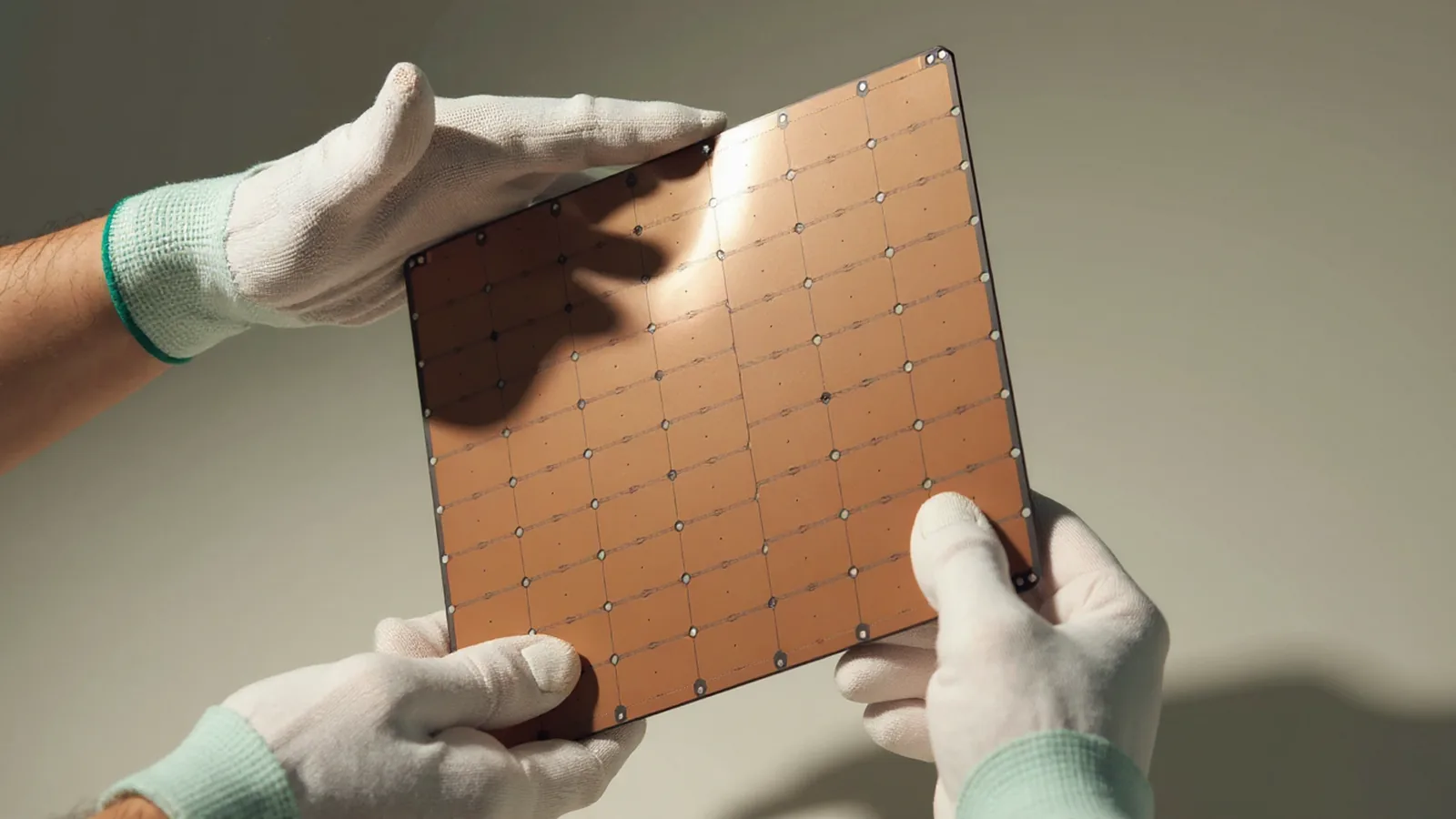
Every so often a partner forwards me a tech headline and asks whether it changes anything for the firm. Recently it was a photo of a chip the size of a dinner plate, sold with the promise that it runs the fastest AI in the world. The honest question underneath was: is this something I have to buy? The short answer is no. The longer answer is more interesting, because that piece of silicon captures a problem that does concern you.
Let me tell you what it is, why the industry is betting on it, and which decision of yours hides behind the headline. Because you will not choose the chip. Where your data runs, that one is yours.
What a whole-wafer chip is
Processors are made on silicon wafers, discs about thirty centimeters across. The normal way is to print hundreds of small chips on that wafer and then cut it apart, like a sheet of cookies snapped into pieces. Each cut square is a processor (a GPU, for instance) that is later wired to others so they can work as a team.
A whole-wafer chip does the opposite: instead of cutting the wafer, it leaves it intact and treats the whole thing as one giant processor. The real, commercial example is the WSE-3 from a company called Cerebras, a single piece of 46,225 square millimeters of silicon, with roughly 4 trillion transistors and 900,000 compute cores, built by TSMC on a 5-nanometer process. An independent technical analysis describes it as about 56 times larger than an NVIDIA H100, the normal size of a high-end GPU. It is, literally, the wafer left uncut.
Why that matters for AI
The advantage is not size for bragging. When you cut the wafer into many chips, those chips have to talk to each other over external cables, and that is where time and energy leak away. A large AI model is split across dozens of cards that pass data back and forth thousands of times a second, and that traffic is one of the real bottlenecks of modern AI.
By leaving the wafer whole, almost all of that conversation happens inside the same silicon, far faster than any cable. The WSE-3 also carries 44 GB of very fast memory sitting right next to the cores, instead of relying only on external memory the way GPUs do. When the model fits in that on-chip memory, answers come out very quickly, even for a single user. For inference (when the already-trained model answers questions) that design comfortably beats an equivalent GPU server, though direct comparisons always come with configuration asterisks.
The cost of not cutting the wafer
None of this is free. The industry's old rule says the bigger the chip, the worse the manufacturing yield, because any microscopic defect on the wafer ruins the piece, and a whole wafer would accumulate too many defects to be usable. For decades that made the whole-wafer idea look impossible.
The way around it was to design tiny cores, about 0.05 square millimeters each, and a communication fabric that routes around the ones that come out defective, like a city detouring traffic off a broken street. Cerebras claims it uses 93 percent of the silicon this way and reaches yields comparable to a normal GPU. That is their figure, but the principle is sound: you do not avoid defects, you tolerate them.
The other costs are more down to earth. A chip like this draws and dissipates an enormous amount of heat, so it lives in a large chassis with liquid cooling and redundant pumps, nothing like a desktop computer. And because it is one huge piece, you cannot split it for small jobs: either you use it hard or you waste a very expensive machine.
Who actually uses it
To avoid the hype, it helps to separate what is proven from what is promised. There are real, documented customers. G42, a technology group in Abu Dhabi, built a supercomputer called Condor Galaxy 3 with these chips. Mistral, the European open-model company, uses them for the near-instant answers in its chat. Perplexity uses them for its Sonar search engine, built on a 70-billion-parameter model.
On OpenAI, the maker of ChatGPT, it is worth being precise. It has been reported, in a statement from Cerebras itself and in a Bloomberg article from February 2026, that OpenAI signed a deal to deploy 750 megawatts of these whole-wafer systems and launched its first model running on them, one designed for fast coding. I say it with that caution on purpose: part of the source is the interested company. And it should not be confused with a separate deal, OpenAI's collaboration with Broadcom to design its own custom accelerators (10 gigawatts), which are not whole-wafer chips. They are separate bets: no one is replacing anyone, they are diversifying.
What this means for your firm
This is where the headline lands in your reality. This is the infrastructure the AI services you already use run on, and it explains very concrete things: why some services answer faster than others, why computing capacity became the most contested resource in the industry, and why providers sign deals measured in hundreds of megawatts. When a service answers you in a blink, there are silicon decisions like this one on the other side.
The note for your firm is simpler and less dramatic: the whole industry is deciding where and how its computing runs, and that same question exists at your scale. When you use AI, your data runs somewhere: a public service, a private API under contract, or an open model on your own servers. You do not need to understand silicon to keep that map clear; it is enough to know which information is sensitive and where it travels. That judgment can be built, and it is the same judgment we work on piece by piece in training.