
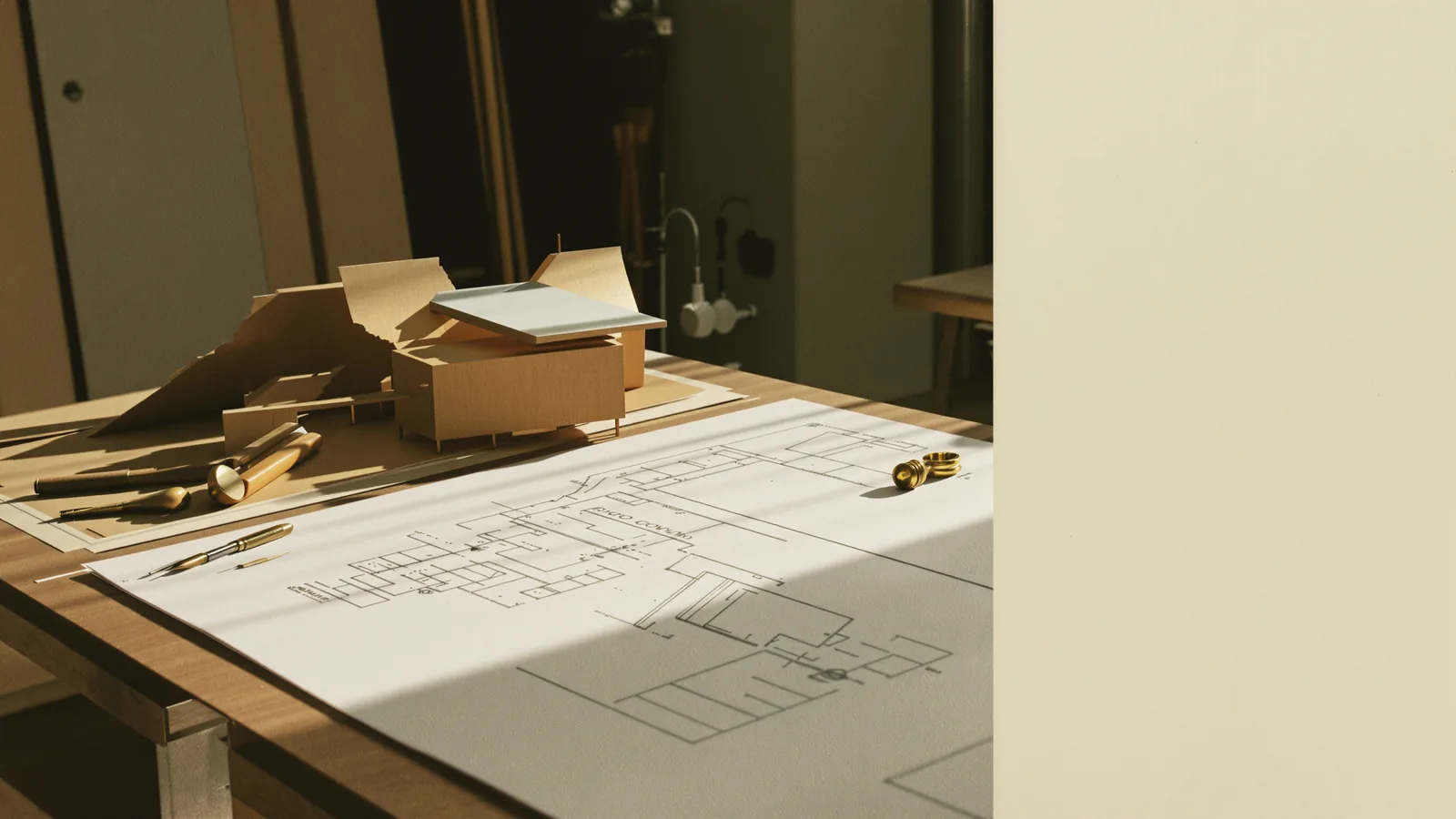
The question partners in an architecture studio ask me is almost never whether AI is useful. It is which part of the process they can lean on without putting their name at risk. I think that is the right question, because AI in architecture is not one thing. It hugely accelerates some tasks and is genuinely dangerous in others. Everything depends on knowing which is which before you hand work to a client or an authority.
Let me be concrete about where I have seen it genuinely pay off in 2025 and 2026, and where it should be kept at arm's length. This is the discipline of a practice that stands behind what it signs, not a stance against the tool. Adoption is already high: in industry surveys, close to half of architects use some form of AI in their work, mostly for concept imagery. The question is no longer whether it enters your studio, but how.
Renders and conceptual iteration: this is where it accelerates
The stage most exposed to AI is the earliest one: exploring massing, atmosphere, materials, and light while nothing is decided yet. Tools like Midjourney produce striking images for mood boards and competitions, but they invent geometry and know nothing about your model, so they inspire rather than document. At the other end sit tools like Veras, which plug directly into Revit, SketchUp, Rhino, and Archicad and return a render in fifteen to thirty seconds. Being able to show a client several material or lighting options in real time, inside your own model, has real value in a meeting.
Here is the contrarian part almost nobody tells you: generating a hundred variations a day is not the same as making progress. When the tool produces images faster than you can judge them, the risk is accumulating noise instead of insight, and every studio ending up delivering the same homogenized aesthetic the model learned. AI gives you exploration speed. Design direction is still yours, and it pays to decide what you are looking for before letting an infinite catalog decide for you.
Project descriptions and written deliverables
The second place AI saves real hours is text. A project description, the conceptual narrative for a competition, client correspondence, a handover script: all of it starts far faster from a generated first draft that you then correct. Don't use it to write for you; use it so you never start from a blank page. The draft gives you structure and vocabulary, and you supply the precision, the studio's voice, and the facts the model does not have.
One non-optional caution: do not paste confidential project or client information into the free tiers of these tools, because by default they can retain and learn from what you type. Drawings, budgets, site data, or client details deserve a tool with enterprise terms and an agreement in place. The convenience of the tab you already have open is not worth a leak.
Preliminary quantities, with the word preliminary underlined
AI is also useful for estimating quantities and orders of magnitude early: a first approximation of areas, volumes, or line items that helps you size an idea before investing hours in a formal takeoff. As a starting point, it is helpful. As a number you deliver, it is not. Anything that comes out of it gets verified against your survey, your model, and your real prices, because a generated figure sounds exactly as convincing as a correct one, and that is precisely the trap.
What you must not delegate
There are three things that, in your practice, cannot leave the judgment of a licensed person, no matter how good the tool's output looks:
- Structural judgment. An image model will happily draw you an impossible cantilever without blinking. Sizing, loads, and safety are calculation and professional responsibility, not a statistical suggestion.
- Code compliance. Building code, land use, civil protection, accessibility: the regulation that applies to your site and your municipality is something you confirm against the source, not against what a model recalls from someone else's text.
- The professional stamp. The signature of the responsible architect of record is not delegated. The one who answers to the authority and the client is a person, not a software vendor.
The most dangerous bias here is automation bias: a polished output looks reviewed even when it starts from an incomplete or wrong assumption, and it slips through unquestioned. It is worth remembering what the professional bodies are already saying. The American Institute of Architects, in its position on AI, insists the tool augments capability but does not replace judgment, and that the architect remains the professional of record. Human oversight and that accountability are exactly what make AI useful and less risky.
Where training comes in
If you read closely, the skill your team needs is knowing which part of the project it belongs in and which part it does not. Switching the tool on is not the skill. That judgment does not arrive with a license purchase. It is built by training your people to use AI with confidence in conceptual iteration and in writing, and to know, without having to stop and think, where the line sits that nothing crosses: the calculation, the code, and the signature. That is the work I do with studios: teaching the team to tell the two zones apart so AI gives them speed without costing them the name it took so long to build.